No Office Required: The UK Founder’s Lean Route to Seven-Figure European Sales
There is a moment in every growing UK business when someone says the word “Europe” and the room immediately starts spending money. A country manager. A small office. A legal entity. A website translated into five languages before anyone has checked whether the German buyer actually cares. It feels like progress because it looks like a corporate expansion. It rarely is.
The founders building seven-figure EU revenue in 2026 are doing something far less glamorous and far more effective. They are treating exporting as a sequence, not a statement. They start with a partner who already owns the customer relationship, plug into local fulfilment, get VAT and customs boringly compliant, and only then think about anything that resembles a country launch. The office can wait. In many cases, it never arrives.
Start with a distributor, not a desk
The fastest way to learn whether a market wants your product is to sell through someone who already sells there. A distributor, a specialist marketplace, an agent with a book of trade buyers — any of these gives you revenue signal without a payroll commitment. You are renting credibility and shelf space rather than building it from scratch.
The trick is to choose partners who are not simply order-takers. You want someone with technical knowledge, stock-holding capability, and a reason to push your line rather than treat it as a catalogue filler. A good distributor will tell you what your packaging should say, which SKUs need local certification, and where your pricing is out of line. That intelligence is worth more than a year of desk research.
Manchester manufacturers have used this route for decades. What is different now is the speed. A founder in Leeds can have a Dutch distributor trialling a pallet within weeks, not quarters. The cash cycle is short, the feedback loop is tight, and the downside is a few samples and a couple of awkward calls. That is a much better first bet than a three-year lease on a business park unit near Schiphol.
Fulfilment is the real country launch
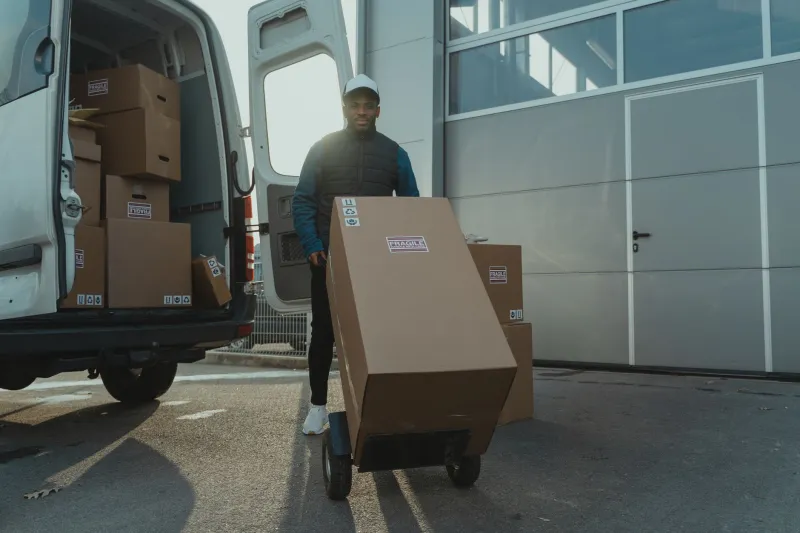
Customers do not care where your head office is. They care how fast the parcel arrives and how easy the return is. That is why localised fulfilment is the single highest-leverage move in a lean export plan. A 3PL in the Netherlands or Germany can put your stock inside the EU, cut delivery times from a week to a day or two, and remove the customs friction that makes cross-border buying feel like a chore.
You do not need a warehouse of your own. You need a partner who can receive a pallet, pick, pack, and return. Start with one SKU range and one 3PL. Measure the delivery promise against your UK baseline. If the gap is still wide, fix it before you spend a penny on local marketing. A seven-figure EU line is built on repeat orders, and repeat orders are built on the parcel arriving when the customer expects it.
There is a cash-flow angle here too. Stock sitting in an EU 3PL is stock you have already paid for, so the temptation is to overfill the shelves. Resist it. The founders who scale cleanly keep their EU inventory lean and replenish on a rhythm. They treat the 3PL as a tap, not a reservoir.
Get VAT and IOSS boring before you get busy
The least exciting part of exporting is also the part that quietly decides whether your margin survives. VAT registration, IOSS numbers, EORI details, incoterms, and duty classification are not glamorous, but they are the plumbing. If the plumbing leaks, every sale drips profit.
Get the paperwork sorted before volume arrives. That means understanding who is the importer of record, how VAT is collected and remitted, and what your responsibilities are under the Incoterms you have chosen. A DDP arrangement looks simple to the buyer and complicated to you. A DAP arrangement shifts the customs burden but can create a poor customer experience if the carrier surprises the buyer with a bill. Neither is wrong. What is wrong is not knowing which one you are running.
Use a specialist adviser for the first setup, then bring it in-house as a checklist. The goal is not to become a customs expert. The goal is to make the process so predictable that your team stops fearing it. Once VAT and IOSS are boring, you can scale without the sick feeling that a compliance letter is waiting in the post.
One market, one lightweight playbook
The temptation is to launch everywhere at once because the internet makes it look easy. The reality is that every country has its own payment preferences, delivery expectations, and buyer psychology. A Dutch B2B buyer and a French retail buyer are not the same animal. A single market, launched properly, beats five markets launched badly.
Pick one country where your distributor or 3PL already gives you an edge. Localise the product page, the invoice, and the support email. Add the local payment methods that matter. Then run a deliberately small campaign — a trade show, a LinkedIn push, a partner webinar — and measure the cost of acquiring a repeat customer. If the unit economics work, copy the playbook to the next country. If they do not, you have lost a few thousand pounds, not a year of management attention.
This is where a part-time country lead can be useful, but only after the first revenue is proven. A freelance native speaker with trade experience can do more for your credibility than a full-time hire who spends the first six months learning the market. Keep the contract light. Keep the footprint smaller than your ambition.
The guardrails that keep a small footprint profitable
Exporting does not fail because the market is too hard. It fails because the founder loses control of margin, cash, and focus. Three guardrails matter more than any office.
First, price for the channel. Distributor margins, 3PL fees, duty, and returns all eat into the number you see on the invoice. Build a landed-cost model before you quote. Second, protect the cash cycle. EU stock, extended payment terms, and VAT timing can tie up more cash than a domestic expansion ever would. Third, cap the experiment. Give each new country a budget and a review date. If the signal is not there, stop.
The founders who build seven-figure European revenue without an office are not doing anything magical. They are simply refusing to confuse activity with progress. They start with a partner, localise the parcel, make compliance dull, and keep the team tiny until the revenue justifies more. Europe is not a corporate exercise for big companies. It is a growth lever for founders who are willing to pull it in the right order.